 EN
EN
 AR
AR
 FR
FR
 PT
PT
 RU
RU
 ES
ES
 ID
ID
 TH
TH
 KO
KO
 JA
JA
 VI
VI
 NL
NL
 IT
IT
 DE
DE


Application of Cartesian Robots in Food Packaging
Application of Cartesian Robots in Food Packaging
In the pursuit of efficiency and hygiene, automated packaging has become key to competitiveness in the modern food industry. As a versatile tool in industrial automation, the Cartesian Robot is playing an increasingly vital role on food packaging lines due to its high precision, load capacity, and modular flexibility.
Core Architecture Analysis
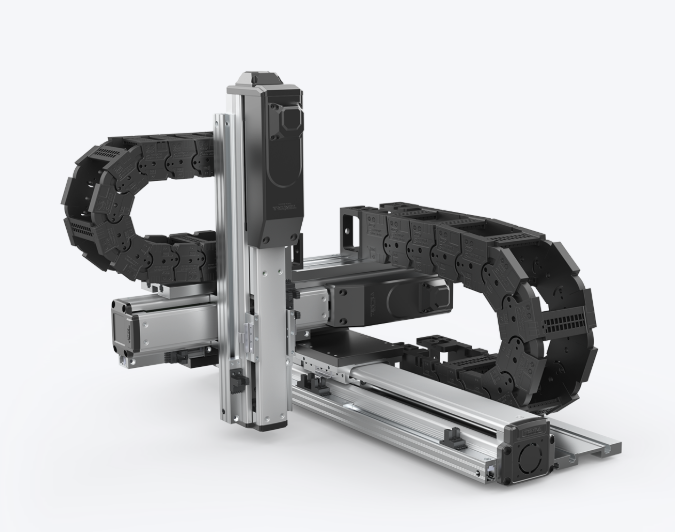
The Cartesian robot, also known as a rectangular-coordinate robot or gantry robot, is built upon the X, Y, and Z axes of a rectangular coordinate system. Its key components include:
• Linear Motion Axes: These are the X, Y, and Z axes, usually constructed from high-rigidity aluminum profiles, precision linear guides, and sliders, enabling precise linear movements in multi-dimensional space.
• Drive and Transmission System: Utilizing high-dynamic servo or stepper motors, combined with belts, ball screws, or racks, this system ensures speed and positioning accuracy.
• End Effectors (Grippers): Depending on the application, robots can be equipped with vacuum suction cups or mechanical clamps to ensure damage-free handling of food products or boxes.
• Cable Protection System: The black "cable carriers" shown in the image manage and protect cables and air hoses, preventing wear and tear during high-speed motion, ensuring long-term system stability.
Application Advantages and Uses
The Cartesian robot offers significant advantages in the food industry:
• Large Stroke and High Load Capacity: With axis strokes extending several meters and robust load capacities, they are ideal for handling large-scale boxed or bagged food items.
• High Speed and Precision: They can achieve cycle times measured in seconds while maintaining high repeatability, often down to sub-millimeter accuracy.
• Simple Structure and Ease of Maintenance: Compared to articulated robots, they have intuitive control systems, lower costs, and longer maintenance intervals, making them well-suited for the high-intensity demands of food workshops.
Specific Applications and Equipment in Food Packaging
Cartesian robots can be seamlessly integrated into various food packaging machines to build fully automated lines:
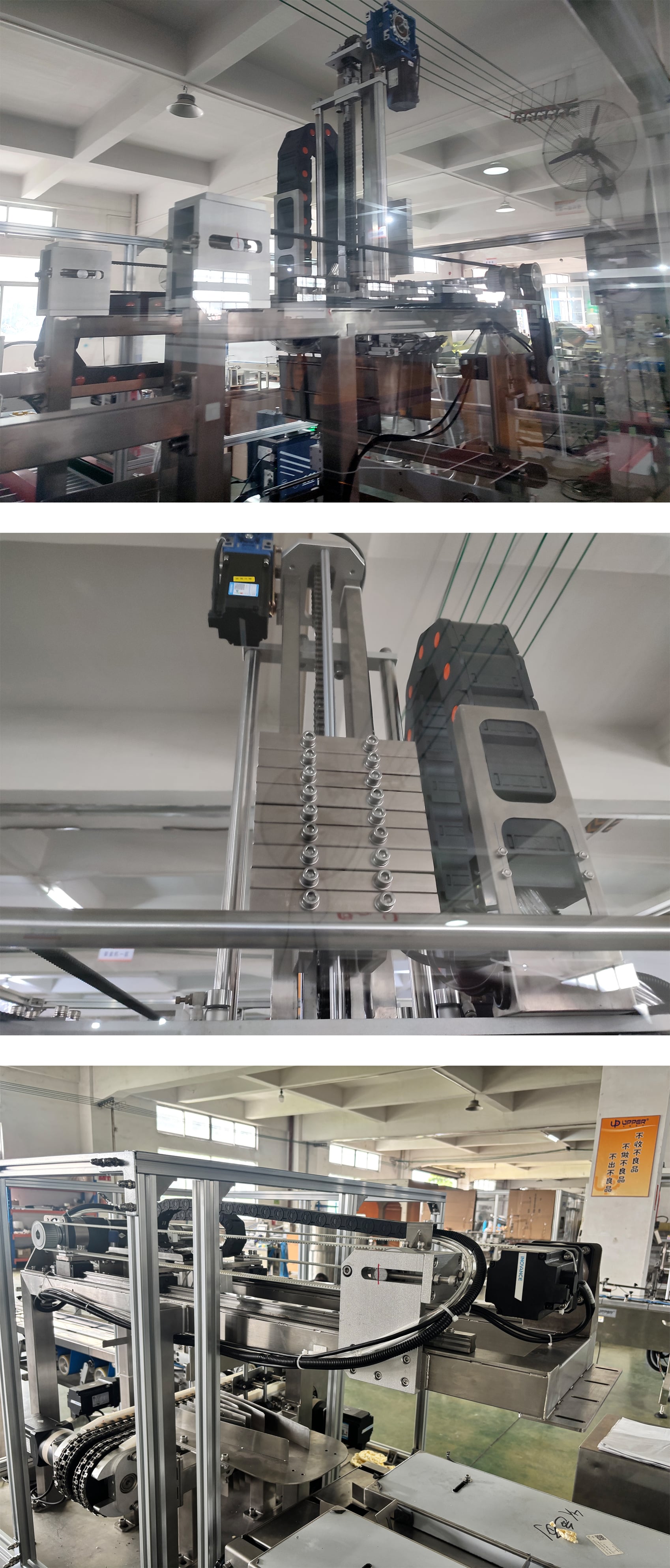
1.Collecting and Sorting Machines (Feeding Lines): Robots can quickly and orderly arrange scattered or directionally fed food items, converting chaos into a structured stream for subsequent packaging steps.
2.Automatic Cartoning Machines: This is one of the most mature applications. Through precise motion paths, robots execute automated carton packing, case handling, and even complex palletizing tasks.
3.Boxing and Sealing Support: They can work alongside secondary packaging machines to complete the folding, sealing, and final palletizing of finished goods.
Conclusion
With its modular flexibility and high reliability, the Cartesian robot is a core driver for the "Industry 4.0" transformation in food packaging. By integrating these robots with sorting, cartoning, and palletizing equipment, food manufacturers can significantly boost efficiency and consistency while reducing labor costs. It is an essential cornerstone for achieving intelligent manufacturing in modern food factories.